
Atelier
Inside the Atelier
The FIONÉE Atelier is not a factory floor. It is a room of attention — where raw materials are weighed, textures are tested against skin, and formulas are refined until they earn their place in a daily ritual. To step inside is to understand FIONÉE as a maison: shaped by hand, guided by restraint, and committed to sensorial intelligence. Nothing here is staged for spectacle. Work proceeds at the pace of observation — a serum returned to the bench because the finish argued with the light, an emulsion held back because it asked the skin to host too much at once. The Atelier is where the house’s voice becomes material.
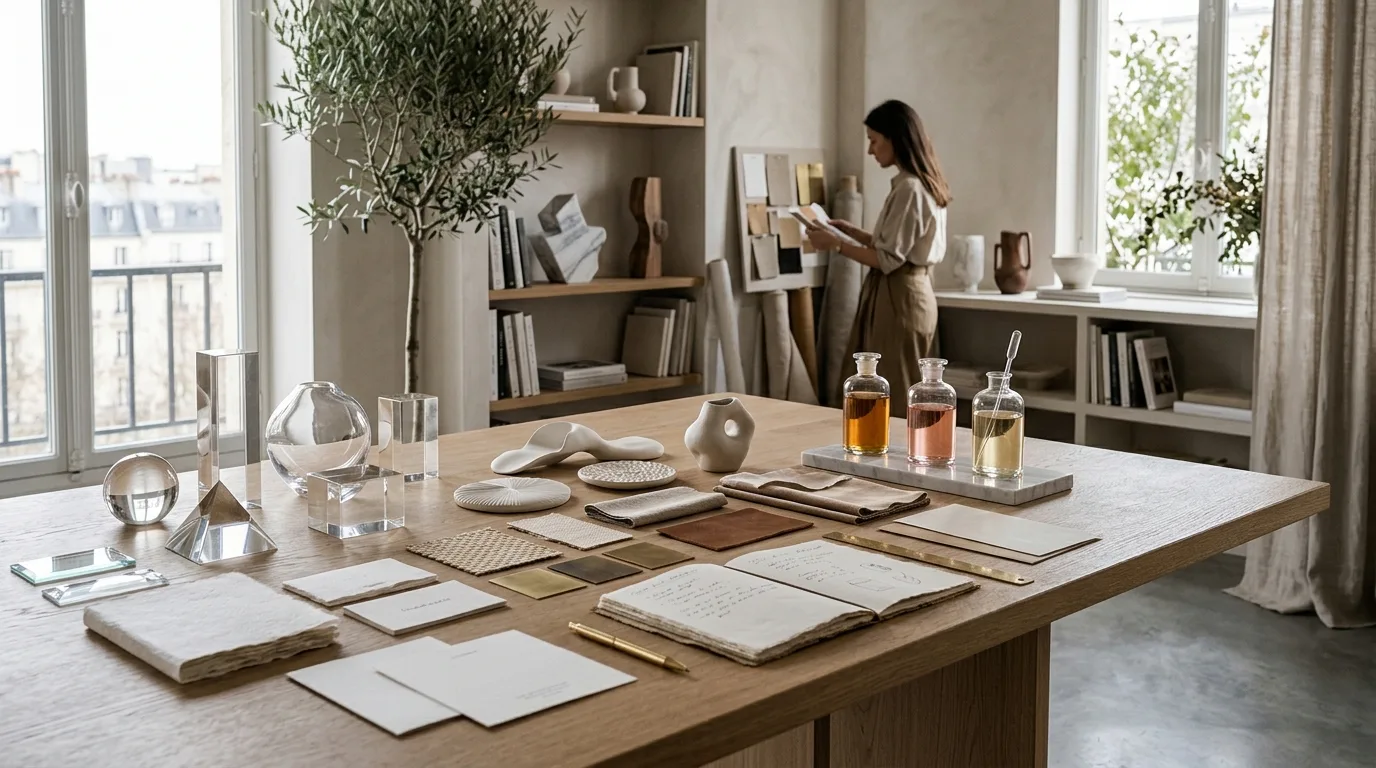
Precision without spectacle — craft that recedes so texture can speak.
A maison, not a laboratory
FIONÉE occupies the space between science and sensibility. Formulation here is rigorous — emulsions balanced, actives considered, stability tested — yet the outcome is always experienced through touch. A serum must glide. A cream must cushion without opacity. An essence must prepare the surface for what follows. The Atelier holds both registers: the discipline of formulation and the culture of texture. It refuses the theatre of a white-coat demonstration and the opposite error of treating craft as mystique. What matters is whether a formula can live in a morning without apology, and in an evening without demanding performance. That dual standard — technical soundness and lived pleasure — is the maison’s real laboratory.
Hydration as material — the macro language of formulation craft.
Materials in dialogue
Each formula begins in material dialogue: peptides considered for their place in cosmetic skincare, botanical extracts weighed for sensorial contribution, humectants chosen for how they sit on skin rather than on a data sheet. Percentages and final INCI remain governed elsewhere; the Atelier speaks in texture, finish and ritual fit. Nothing is added for novelty alone. A material must argue for itself in the hand — how it layers, how it disappears, whether it leaves skin looking composed or merely coated. Dialogue also means refusal. Some contemporary actives arrive with a volume of conversation that exceeds what the house will claim. Those materials are either declined or held inside language that stays cosmetic: appearance, feel, daily use. The Atelier prefers a quieter shelf to a louder story.
Texture as verdict
In the Atelier, texture is the first and final test. Gel, serum, cream and emulsion each carry a distinct rhythm — weightless preparation, concentrated delivery, comforting closure. A formula that performs on paper but fails in the hand does not leave the room. This is why AURÉLIS feels composed rather than assembled: each texture has been argued for, refined, and released only when it belongs. Texture is also how rituals stay intelligible. If every step feels identical, composition collapses into repetition. If every step competes, composition collapses into noise. The verdict is therefore architectural as well as sensorial: does this finish open space for what follows, or does it close the sequence too early? Only textures that answer that question well are allowed to become public.
The Atelier register — attention, materials and unforced craft.
Release is an editorial decision — knowing when a formula is complete.
Listen, observe, release
The Atelier sequence — Listen, Observe, Create, Refine, Preview, Release — is not marketing architecture. It is how work actually moves. Listening to how skin receives a texture. Observing how light returns after application. Creating pairings that respect morning brevity and evening pause. Refining until a finish stops arguing with the rest of the day. Previewing in the climate of the house before anything is asked to represent FIONÉE in public. Release is the editorial decision that a formula is complete enough to leave the room — not that it is perfect in every future context, but that it has earned a place in a daily practice. The Ritual Composer and concern pathways on the site extend this logic into public form: orientation without prescription.
Observation as a working method
Observation in the Atelier is slower than inspiration and more exact than habit. It asks how a cream behaves at the jawline after an hour, how an essence changes the reception of a serum, whether a mask leaves skin feeling replenished or merely occupied. Light is part of the method: a finish that looks composed under champagne tone may look different under cooler morning windows, and both conditions matter. Observation also watches language. If a formula can only be described with borrowed medical gravity, it has not yet found its place in this house. The work continues until the sentence and the texture agree — cosmetic, sensorial, and precise enough to stand without exaggeration.
From bench to ritual
A formula does not leave the Atelier as an isolated object. It leaves as a candidate for ritual — something that can sit beside other textures without forcing the skin into a crowd. Pairings are considered early: an essence that prepares without residue, a serum that settles before a cream closes, a mask that marks pause rather than claiming the entire evening. This is why AURÉLIS can be read as a vocabulary. The Atelier designs for adjacency. The question is never only whether a single gesture is pleasant, but whether it remains pleasant when the day asks for two or three. Ritual fitness is craft, not afterthought.
Ingredient craft in close register — material considered before claim.
The idea of a beauty maison
A maison implies continuity — a house with rooms, chapters and a recognizable voice. FIONÉE is that house. AURÉLIS is its first named preview. The Atelier is where the voice is shaped: through material, through precision, through the refusal to confuse volume with value. What leaves these walls is meant to be lived with — quietly, daily, without announcement. Continuity does not mean repetition. It means that a future chapter, when it arrives, should feel as if it belongs to the same climate: cream and pearl, restrained scent, textures that respect light. The Atelier protects that continuity by declining what would only make the house louder.
Stillness at the opening
The Atelier page now opens in stillness — a single editorial still — so that motion can belong to the sequence that follows, not compete with it. Craft does not need a montage to prove it is happening. The visitor should arrive in a room, then choose a step. That order is itself a lesson in restraint: one climate first, then work. Stillness is not emptiness. It is the same discipline the bench practises when a formula is held back another week rather than rushed into public view. Entering slowly is part of understanding how FIONÉE prefers to be known — as a maison that earns attention rather than demanding it, and that treats the first second of arrival as part of the craft.
Craft that refuses spectacle
Spectacle asks craft to prove itself in public. The Atelier declines that demand. There is no montage of pouring, no theatrical close-up of a single drop asked to stand for an entire philosophy. Work remains mostly invisible until a texture is ready to be lived with. That invisibility is not secrecy; it is proportion. A beauty maison that confuses demonstration with authority will eventually write louder than it formulates. FIONÉE prefers the opposite ratio: more time on the bench, fewer claims in the room, and a public face that trusts the visitor to feel the difference without being shown how the sausage was made — or, more accurately, how the emulsion was argued into belonging.