
Maison
The Mood of Maison
Maison is not a corridor between pages. It is the temperature of the house — the way light sits on a surface, the pace at which a ritual is allowed to unfold, the feeling that skincare belongs to a room rather than a shelf. To enter Maison is to enter FIONÉE’s habitat: private, composed, and deliberately unhurried. The page does not explain the brand so much as let the brand be inhabited. Atmosphere becomes orientation. Before a visitor meets a formula, a concern, or a Journal note, they meet a climate — cream and pearl, quiet geometry, the suggestion that beauty can be spatial without becoming a showroom.
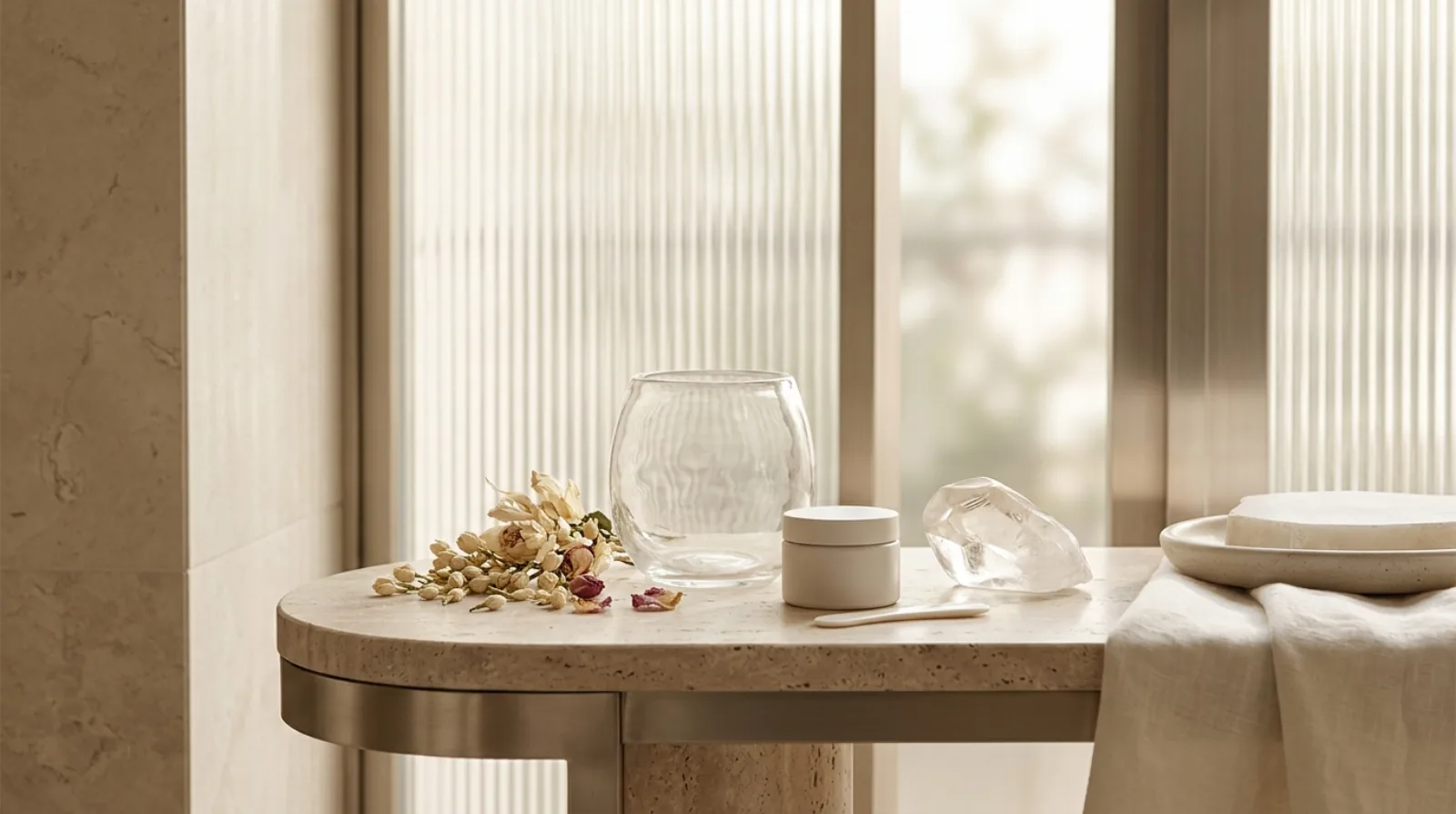
A maison is a climate — not a catalogue, and not a biography.
Habitat, not headquarters
FIONÉE treats Maison as an editorial residence. It is where the brand’s taste becomes spatial: cream and pearl, quiet geometry, the suggestion of rooms that hold ritual rather than display it. Nothing here is a storefront. Nothing here is a corporate origin story. The page exists so a visitor can feel the world the formulas inhabit — the same world that shapes Atelier, Journal, and the way AURÉLIS is shown. Headquarters imply process and hierarchy. Habitat implies tempo and belonging. Maison chooses the second. A visitor is not processed through rooms toward a conclusion; they are allowed to stay long enough for the temperature to register. That staying is the point.
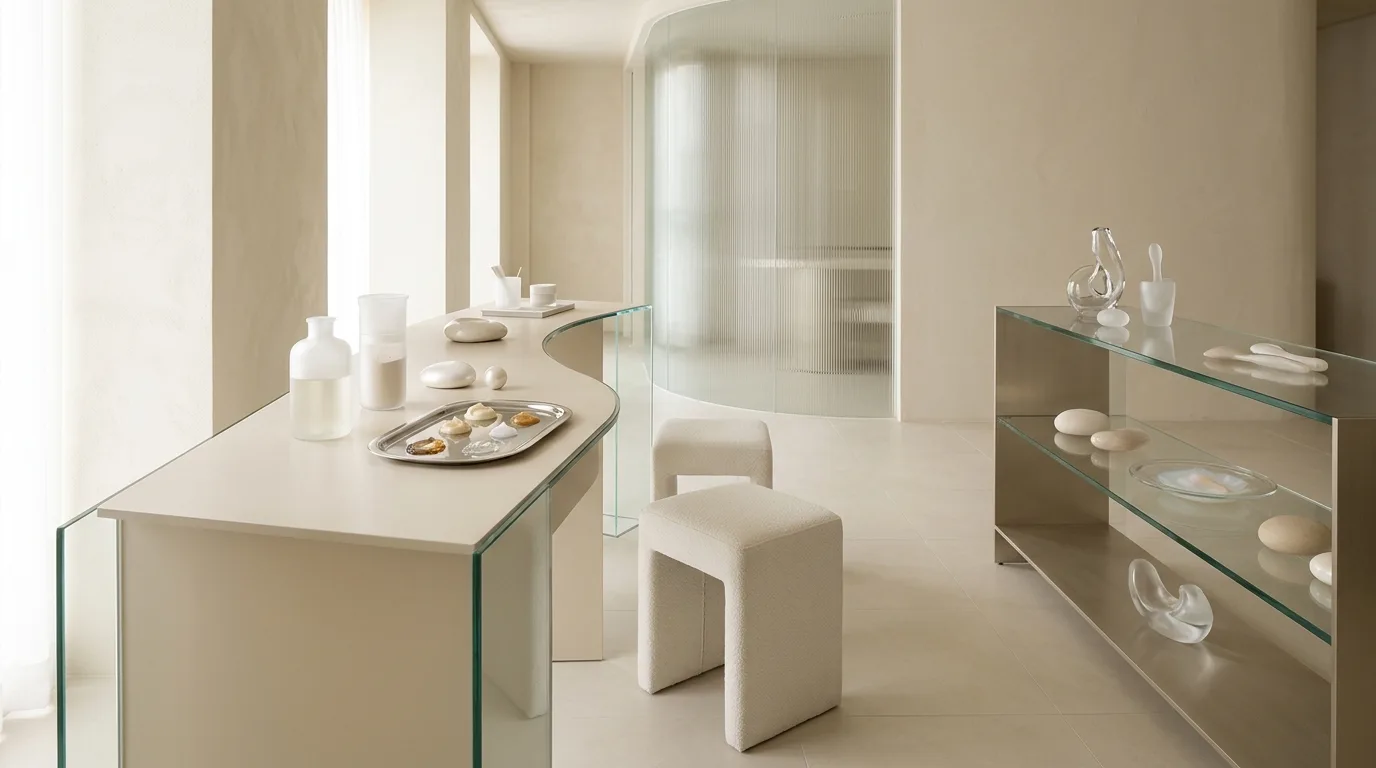
The first room of the house — light, architecture and unforced calm.
The register of quiet luxury
Quiet luxury, in this house, is not a trend label. It is a refusal of noise: no promotional temperature, no stacked claims, no visual clutter competing for the first glance. Materials are allowed to speak at their own volume. A reflective floor, a pale architectural plane, a vessel catching champagne light — these are the sentences Maison writes. The visitor is trusted to read them without being instructed. Quiet does not mean empty. It means that each object and each plane has been given enough air to hold attention without raising its voice. When luxury becomes loud, it stops being a climate and becomes a costume. Maison keeps the climate.
Light as furniture
In Maison, light behaves like furniture — placed with intent, not poured everywhere. Champagne tone softens edges; cooler planes keep a morning clarity; shadows are allowed to remain where they help a surface feel dimensional rather than flat. This is the same lighting brief that governs radiance language and collection photography, brought indoors as habitat. A house that understands light does not need glitter to feel luminous. It needs planes that catch, materials that return, and enough negative space that a single reflection can matter. Walking through Maison should teach the eye what FIONÉE means by composure long before a product name appears.
Rooms of ritual
A habitat implies rooms with different tempos. Morning might be a cooler, more vertical light; evening a slower, more cushioned one. Maison does not prescribe those hours. It simply holds them as a possibility — the way a well-made interior holds both conversation and silence. Rituals live here as gestures: the press of an essence, the pause before a cream, the decision to stop before a sequence becomes busy. The rooms are not labelled by concern, yet a visitor who knows radiance, recovery, firmness and clarity will feel those climates as different kinds of quiet. Habitat absorbs ritual without turning it into choreography. The body already knows how to move through a room; Maison trusts that knowledge.
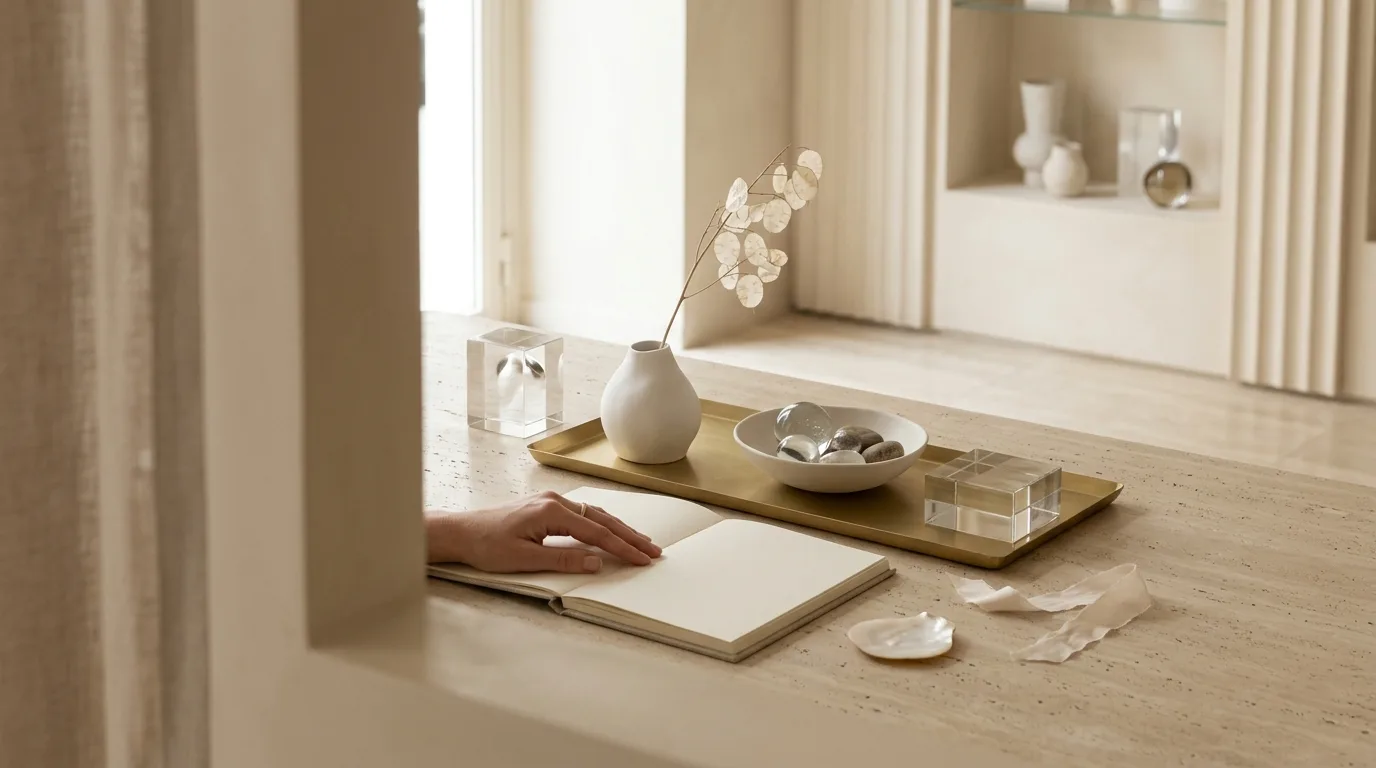
A second register of the house — closer, more intimate, still architectural.
Intimacy here is spatial: fewer objects, more attention.
Taste as environment
Brand taste is often reduced to a palette. Maison insists it is also an environment: how much empty space a composition can bear, how a still is cropped, how little type is required once the image is doing its work. FIONÉE’s cream, pearl, champagne, silver and black are not decorations applied afterward. They are the climate in which every other page should feel at home — including the Journal notes that return to this room. Environment also governs motion: when something moves, it should feel like air shifting in a quiet interior, not like a demonstration. Taste, held this way, becomes navigable. A visitor can tell, almost immediately, whether a new still or a new sentence still belongs to the house.
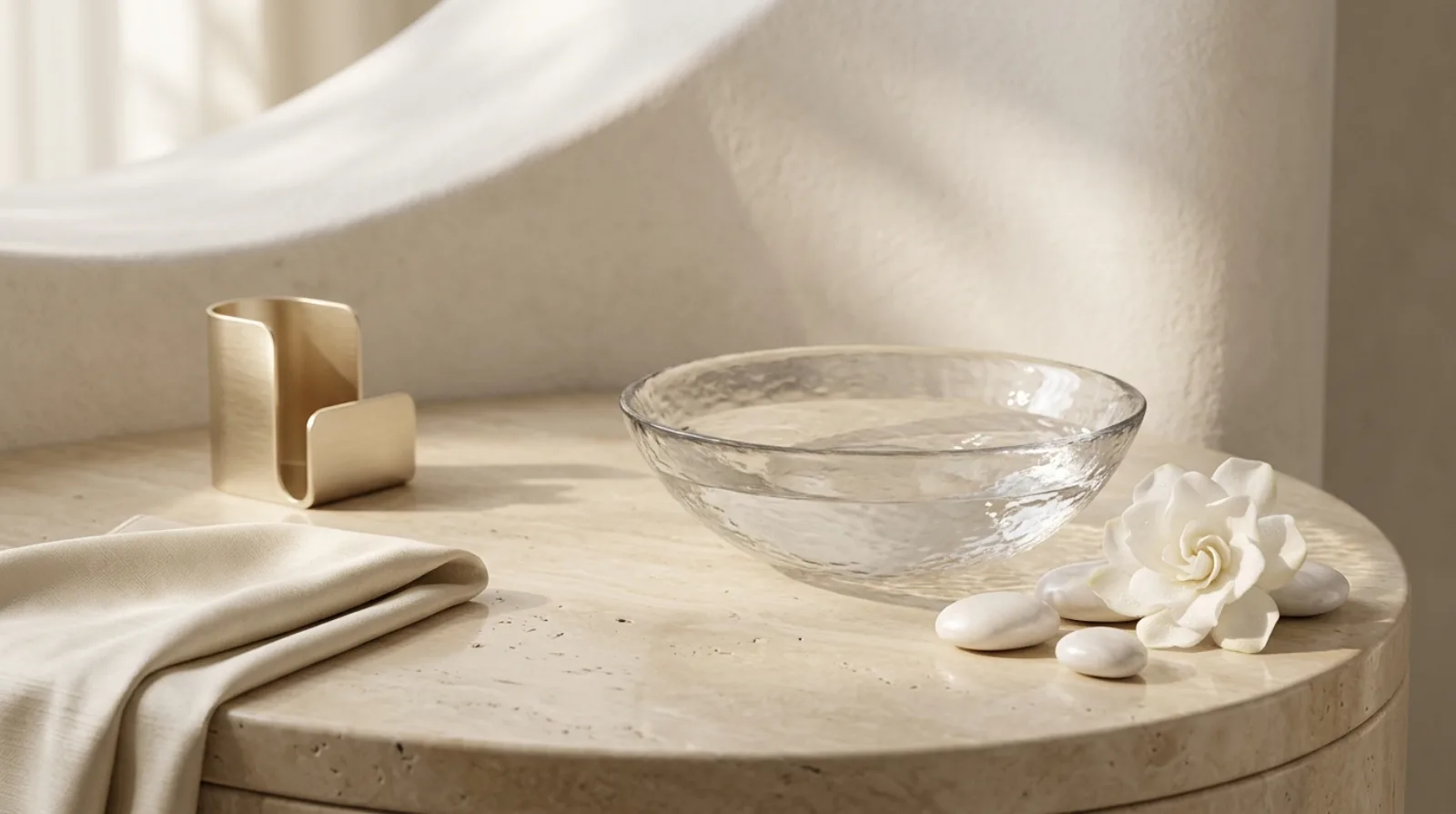
A further register — editorial calm carried through architectural depth.
Private, not secretive
The house is private without being closed. Visitors are welcome; they are not processed. There is no funnel disguised as atmosphere, no invitation that behaves like an offer. What Maison offers is orientation of feeling: this is how FIONÉE prefers the world to look and move. From here, Atelier shows how formulas are considered; Journal shows how they are thought; AURÉLIS shows one preview chapter of what the house currently holds. Privacy, in this sense, is a hospitality of pace. It protects the visitor from being hurried into commerce language on a brand site that is not a store. It also protects the brand from explaining itself into thinness. Some houses are felt before they are summarised. Maison insists on that order.
Beyond the first collection
Maison exists partly so AURÉLIS cannot be mistaken for the whole of FIONÉE. A preview chapter needs a house larger than itself — rooms that remain when seven formulas are set down, a climate that can host a future chapter without rewriting the furniture. Walking Maison should restore scale: the collection is exact; the habitat is wider. That width is not vagueness. It is the deliberate decision to keep brand identity spatial and sensorial rather than catalogue-bound. When the site becomes too specific — too much product, too much concern — Maison is the room that returns the visitor to temperature, light and unforced calm.
A close, not a conclusion
To leave Maison should feel like leaving a room rather than finishing an article. The last impression is sensorial: light held on a surface, a slower breath, the sense that skincare might be part of a life rather than a list. That is the purpose of the page — not to explain the brand, but to let the brand be inhabited. A conclusion would seal the house. A close merely dims the lights for a moment and leaves the door unlatched. Return when other pages have become too particular. The mood will still be there: composed, private, and quietly exact.
Maison as a returning measure
Use Maison as a measure when elsewhere the site has become dense with concern pathways, formula detail or Journal argument. Ask whether a new still still belongs to this climate. Ask whether a sentence still sounds like a room rather than a pitch. Ask whether AURÉLIS, in this light, still reads as a chapter rather than a ceiling. The mood is not nostalgia for emptiness; it is a working standard for prestige that refuses noise. When the measure is met, the house feels continuous. When it is not, something has left the register — and Maison is where you notice first.