
Atelier
The Discipline of Restraint
Restraint is easy to announce and difficult to practise. It asks a house to leave ingredients off a formula, claims off a sentence, objects out of a frame, and steps out of a ritual. At FIONÉE, restraint is not minimalism as style. It is a discipline: the decision, repeated, not to add what would only make the work louder.
Restraint is not less. It is the refusal to dilute what is already enough.
Omission in the Atelier
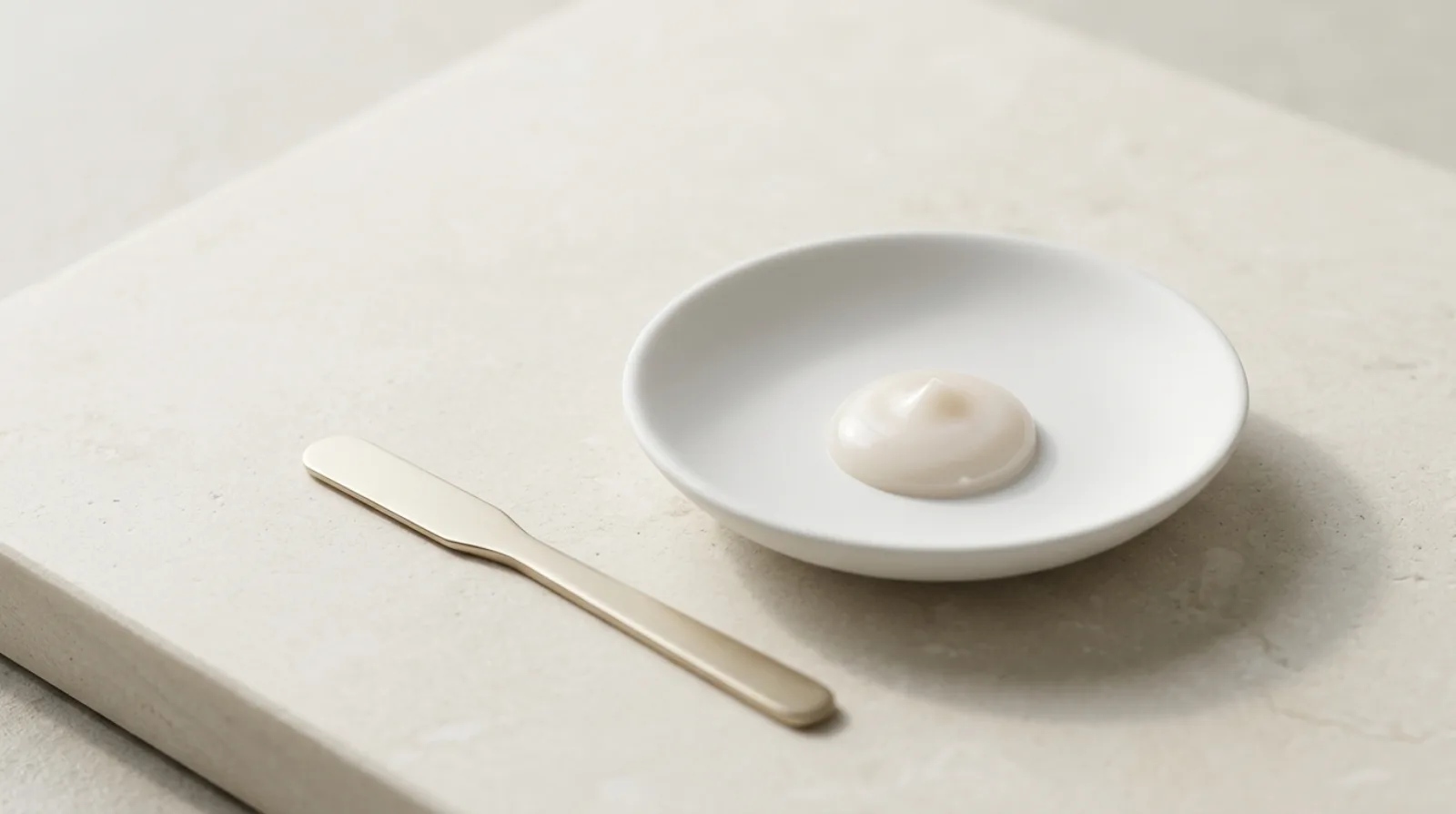
A formula can be crowded in the same way a page can. Too many gestures, too many competing finishes, too much theatre in a single emulsion. The Atelier’s work is often subtraction: a texture simplified until it belongs in a daily sequence; an active considered and then declined because it would force the language into a register the house will not occupy. What remains is not sparse. It is specific. Specificity is the point of omission. A cream that does one thing well protects the ritual around it; a formula asked to perform every role usually performs none with clarity. Restraint here is technical as well as editorial — a decision about what the skin is asked to host at once.
Material without spectacle — one texture, enough negative space.
Language as a boundary
Cosmetic conversation has a habit of borrowing medical gravity. FIONÉE declines that borrowing. Appearance and feel are sufficient. Percentages are not published as proof. Disease is not invited onto the page. This is not caution dressed as elegance. It is a belief that intelligent readers prefer a house that knows the edge of its own claims. Restraint in language protects the formulas as much as it protects the visitor. Words that overreach do not make a texture more intelligent; they only ask the formula to carry a costume it cannot honestly wear. The house prefers sentences that describe what can be felt and seen — luminosity, comfort, finish, poise — and leave the rest unsaid.
Appearance and feel are sufficient. The rest is costume.
Imagery that does not over-explain
A still can be as overworked as a paragraph. FIONÉE prefers images that hold one idea: a climate, a material, a product with authority to be seen. Packaging is never invented to complete a composition. Atmosphere is never asked to impersonate a carton. When a SKU is not ready to be shown as pack, the page remains structured and honest. That honesty is a form of prestige — rarer than a polished fiction. Negative space is part of the argument. An empty plane beside a single texture is not unfinished design; it is the visual equivalent of a sentence that stops when the thought is complete.

The Atelier register — attention without demonstration.
Rituals with a stopping point
An intelligent ritual knows when to end. Layering without pause is not devotion; it is anxiety given a sequence. FIONÉE’s concern pathways — radiance, recovery, firmness, clarity — are vocabularies, not programmes to complete. The Ritual Composer offers pairings as editorial suggestions. The discipline is personal: fewer textures chosen well, applied with attention, stopped before the skin is asked to host a crowd. Stopping is a craft decision. It preserves the finish of each step and keeps the evening from becoming a demonstration of abundance. Enough, held calmly, reads as care; more, forced onward, often reads as noise.
AURÉLIS as a chapter, not a ceiling
Restraint also governs how the collection is framed. AURÉLIS is a preview chapter of the house, not the permanent catalogue of FIONÉE. Seven formulas are not asked to represent every future room. The site does not invent what has not been made. That refusal keeps the brand larger than its first series — and keeps the first series from being stretched into a universe it cannot honestly occupy.
The pleasure of enough
There is a sensorial pleasure in enough: a cream that closes the evening without a sequel, a serum that settles without a second serum required to correct it, a page that ends while the thought is still clear. FIONÉE designs for that pleasure. Prestige, in this house, is the feeling that nothing necessary was withheld — and nothing extra was added to prove importance. Enough is not scarcity. It is proportion — the quiet satisfaction of a ritual, a sentence, or a formula that knows its edge and keeps it.